

Improving on Digital Backs
Thinking about it, the biggest difference between a Digital Camera and a Film camera is simply the capturing method. One is a photosensitive film, the other a photosensitive sensor. In the early days of Digital, companies like Kodak made Digital backs to popular cameras like the Nikon N90s:

Quite the bulk, no? Medium Format users knows what digital backs are, as the back of many medium format cameras like Mamiya can be removed to put in something else.

In 2001 when Silicon Film introduced the EFS-1 the technology was amazing: A digital film that can go inside a film camera. It was not a digital back like the Kodak’s or Mamiya’s but a film replacement. It would require no modification to the original camera and you could use either film or digital as you please.
EFS-1 How it works
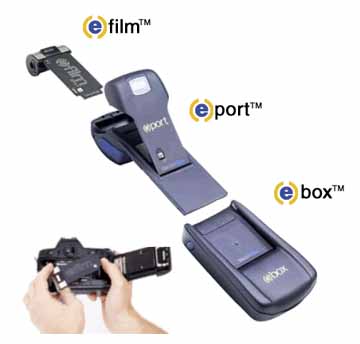
The system had 3 parts: The eFilm, the ebox and the eport. You could slide the eFilm into the ePort to plug into your computer or you could slide them into the eBox to offload the images to a CF card. Everything could be neatly stacked like so:
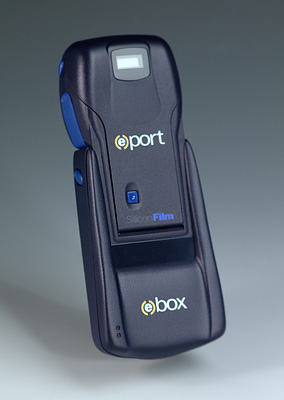
It’s sexy if you ask me. But unfortunately the specs were really low in modern terms.
EFS-1 Specs

The EFS-1 could create 1.3 Megapixel images, could only save 24 images (64mb memory) and was only compatible with a few cameras: Canon’s EOS 1N and EOS A2/5 and Nikon’s F5, F3, and N90/F90. Image wise, here’s a sample:
Heh. Not bad at all if you can forget the cheesy pose and lighting. The digital film was not fullframe, it was slightly smaller than APSC occupying 30% of the frame, and the crop factor was 2.58x.
It never made it to market
When Silicon Film Technologies filed for Chapter 7 bankruptcy in Sept of 2001 EFS-1 was probably 3 months (my estimate, our management was saying 2 months) from reaching the market place. Jon Stern – Senior Engineer, Silicon Film Technologies
The enthusiasm was there, but Silicon film pulled the plug on the project months before coming to market. From the class action suit you can read the issues facing the EFS-1:

(1) the EFS-1 suffered from serious and insurmountable technical design flaws;
(2) these design problems would prevent the unit from passing the required FCC and CE certifications necessary to publicly release the product;
(3) the current design of the EFS-1 was extremely difficult to produce. Specifically, it took hundreds of engineering hours to produce one unit with a success rate of about one unit in three working; 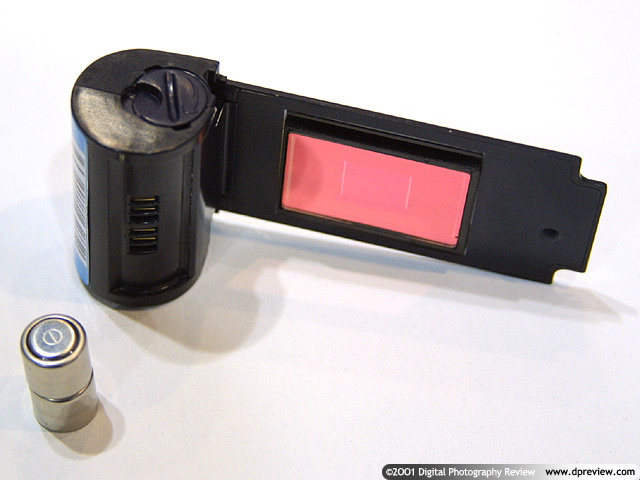
(4) an internal design review was conducted in May, 2001 with all the top officers of SFI, ISC and all of the suppliers for the EFS-1 that were owed millions of dollars. The results of the internal design review were that SFI had a design and parts to produce about 200 units. However, the biggest contract SFI had was for 100 units to a European distributor who would not accept the units since they would not pass CE certification. The web-site sale commitments for domestic sales was for only a few dozen units;
(5) EFS-1 technology presented potential patent conflicts with those already registered by Kodak;
(6) SFI and ISC had scrapped the initial design of the EFS-1 and were scrambling to develop a new prototype; (7) several key employees on the EFS-1 project left SFI further hampering the development process; and (8) William Patton never accepted the position of Chairman and Chief Executive Officer of SFI. In a nutshell it was not going to work for the time. Plus Silicon Film saw that they needed to create 6 different models to cover most of the cameras available. Everything was looking bad for the EFS-1.
Silicon Film EFS10-SF
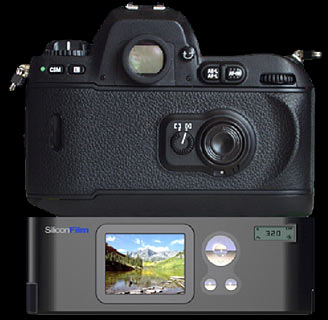
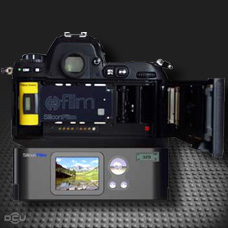
The last ditch effort from the company was the EFS10-SF, this time around it would have 10 megapixel images, it would support CF cards and would “Support most 35mm SLRs”. The product fell into oblivion afterwards and no one ever talked about a device that could fill the promises of the EFS-1. Bummer.
Dreaming of a new EFS-1

It might have been bad timing, but I think if this came out today it would be a hit, make sure it’s at least APSC, 12-16 megapixels, lots of storage space, and support most cameras. It would breathe new life in all of the film cameras and make them new again. I want it!!! More seriously tough, we live in the ear of crowd funding, someone needs to Kickstart this, I think it will meet the money in record time. I love film cameras they are simple, and a device like the EPS-1 would let photographers have the best of both worlds.

I can’t shake my dreams of a Digital Contax G2, this would fulfill it. Plus it would be cool to shoot with one camera, pull out the eFilm, put it in another and resume shooting. This baby needs to be made! Someone please start a Kickstarter or something!
Sources & Further Information
Dead Media Archive (must read)
Updated: Rebuttal
I lifted the criticism against the EFS-1 from the lawsuit, but the Director of Advanced technologies at Silicon Film at the time, Jon Stern, offered this rebuttal:
1) the EFS-1 suffered from serious and insurmountable technical design flaws
Not true. There were many challenges that others could not forsee ways of over-coming (that included Canon’s engineers when they reviewed the idea back in ~99). However, we had a really talented group of engineers and by a mixture of creative thinking and clever engineering, we managed to over-come all of these “insurmountable” flaws.
Re: 2) these design problems would prevent the unit from passing the required FCC and CE certifications necessary to publicly release the product;
I love how that rumor with a grain of truth became an internet fact.
We did have some issue with some of our FCC pre-screens at one point (anyone who has ever done this kind of work knows how frustrating that process can be). This was when downloading from the (e)port to a PC over USB. We modified some of the filtering on the board, but still we were having intermittent fails. Eventually we found that we only failed when using a USB cable without a ferrite chock. Switching over to shipping that type of cable resolved this issue.
As for CE, the first version of our firmware would have failed CE testing because it didn’t have a safe recovery from a crash (that required removal of the batteries). This was not a fundamental issue though. It just needed some new code that the executive management decided to de-prioritize until after the US launch.
Re: 3) the current design of the EFS-1 was extremely difficult to produce. Specifically, it took hundreds of engineering hours to produce one unit with a success rate of about one unit in three working;
We were hand-building the prototypes without the final mass production tooling and it was slow (I don’t know where hundred of engineering hours comes from!) and we had a low yield. This was of concern to me, but mostly from the perspective of MP schedule and ramp.
Anyone who has been involved in real mass production knows that assembly cycle time and yield go through a steep, early learning curve. There were no fundamental issues with our assembly process, which was a lot simpler than DSLRs of the time.
Re: 4) an internal design review was conducted in May, 2001 with all the top officers of SFI, ISC and all of the suppliers for the EFS-1 that were owed millions of dollars. The results of the internal design review were that SFI had a design and parts to produce about 200 units. However, the biggest contract SFI had was for 100 units to a European distributor who would not accept the units since they would not pass CE certification. The web-site sale commitments for domestic sales was for only a few dozen units.
There’s some fairness in this. We were short of ceramics for the sensor package, but already had prototypes for a lower-cost, more easily sourced design. Supply would have been limited until we could ramp that up fully.
We were not taking orders because we were not ready to ship. Our approach was to slowly ramp, in large part because money was tight in 2001 after the dot com crash. We were running on our cash reserves and pre-MP funding was almost impossible to find in a technology-hostile investment climate. The strategy set out by the executive team was to get to limited, volume mass production and product launch, knowing that raising funding for MP ramp would them be much easier.
Re: 5) EFS-1 technology presented potential patent conflicts with those already registered by Kodak
False. Kodak’s patent had a later filing date than ours, and while it included some claims we didn’t have, they were not useful (we didn’t need to infringe on them).
Incidentally, we had an extremely good relationship with Kodak. In large part thanks to one of our board members, Tom Kelly, having formerly been a senior manager at Kodak (he led the team that developed what was marketed as the “Apple Quicktake”), and our CEO Ken Fey having been responsible for setting up Kodak’s point-and-shoot production in China.
Re: 6) SFI and ISC had scrapped the initial design of the EFS-1 and were scrambling to develop a new prototype
False. The orignal ~3x factor in EFS-1 was known to have limited market appeal. I was already leading the development of the next version to address this and enable a larger market acceptance. We already had functional sensors of a 4MP, ~29mm x 19mm sensor for the next product running in the lab.
I’m laughing at this one because somehow a positive (that we were working on a better gen. 2 product) has been perverted in to us scrapping EFS-1.
Re: 7) several key employees on the EFS-1 project left SFI further hampering the development process
We were struggling towards the end. As mentioned above, the dot com bubble bursting had it close to impossible to get VC funding for tech companies (how ironic given that just a few years earlier we were being asked if we could see a way of putting a dot com angle on the business by some investors who would then have been interested). We had to downsize to preserve cash in Sping of 2001 (or thereabout). None of the people let go were deemed essential for the development process.
(8) William Patton never accepted the position of Chairman and Chief Executive Officer of SFI. In a nutshell it was not going to work for the time. Plus Silicon Film saw that they needed to create 6 different models to cover most of the cameras available. Everything was looking bad for the EFS-1.
The William Patton (“General” Patton, as we called him) incident was a funny one. The staff was introduced to him and never saw him again. This was not long before we finally ran out of cash and closed our doors (the week of the 9/11 attacks). I don’t think this affected the outcome, it’s just a strange footnote in the history.
The “6 models” were all the same until the very final step of the assembly process, when the distance between the “film can” and the sensor was locked down. It was all achieved by simply cutting the sensor flex cable to the length required for a particular model, sticking it down and applying the top metal “flag” cover. Oh, we also had a different-colored vinyl label that was applied to the “film can” for each of the six variants. Interestingly, most of the major SLRs were covered by just three of these configurations.
This approach allowed close to complete production and inventorying of the EFS-1. When orders for different models came in we would have been quickly able to configure them (in a few minutes); perform final test; package; and then ship.
I won’t say much about “Silicon Film EFS10-SF”, as I had little involvement after the closure on 9/14/2001. I don’t really consider that to be part of the real Silicon Film history.
Update 2: Check out the “Digipod“