
While medium format users have been enjoying modular systems for quite a while, there is only one small format digital camera that takes this route: The Ricoh GXR.
Introduction
Note: This review has not been successful. The day I planned to go out to shoot did not go as planned and I did not get the shots that could really sell the camera. So read the review but don’t judge the images too hard. You can see better images with the other modules in my Ricoh GXR for street photography here. Also, thef8blog you see on the images is an older name that would morph into Inspired Eye Magazine (Street Photography).
Ricoh enjoyed making great premium point and shoots for a while and in 2009 they came out with the GXR system. The GXR is a modular system, it is composed of a camera slab that you can attach camera modules to. These modules are are composed of a sensor and lens.
So the GXR can turn into a point and shoot with the S10 module or an APSC prime camera with the 50mm or 28mm module. When I personally got the 50mm APSC module, I sold all of my DSLR gear and stuck with it. The idea of being half stuck with a lens-sensor combo did not resonate with many, so Ricoh struck gold by introducing an APSC M Mount module that can handle M mount glass.
Many jumped the boat on this camera, the proofed being that many places were out of stock of the M mount module, useless to say GXR body sales were up too.
Ricoh GXR M Mount review:


Image Quality
By now you know the drill, all the cameras have good enough IQ, blah blah, download the raw files and comparison, blah blah. One thing to note however: The M mount module does not have an AA filter, that means that the images should be sharper, no moiré patterns, etc. What I really like about the GXR is actually the JPGs, they are absolutely great in camera, especially for the black and whites were you can adjust contrast and sharpness.
Being a street photographer, this is one of the rare few cameras that actually deliver the black and whites that I previsualized live on the viewfinder or LCD. Of course I use the RAWs but the JPGs are perfectly usable out of camera. Many flickr feeds are filled with simple out of camera jpgs from the GXR and they look REAL good. The module allows you to compensate for color shading, pincushion, barrel and peripheral illumination. It is also one of the few cameras that can handle wider angles without color shifts. If I used the 15mm Voigtlander with the NEX7 for example, I would have to correct the colors in post, but the M mount can correct it in-camera. Notice how the type of the newspaper are readable even when the shot is facing sunlight:

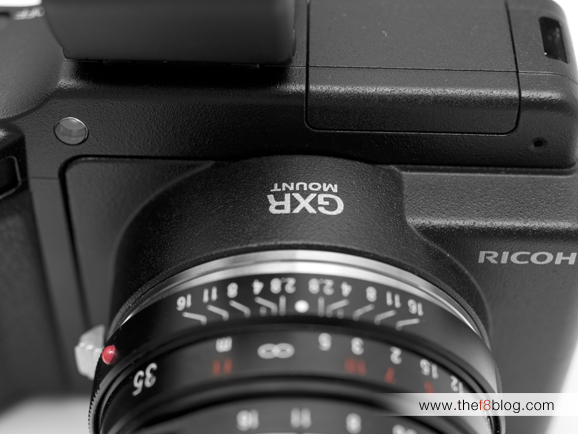
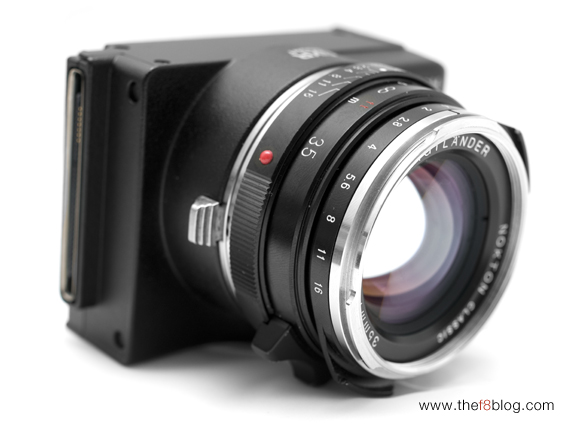
The GXR A12 M might not have the looks, but it sure has that utilitarian feel that I like. Whereas rangefinder lenses make the PEN F look good, they make both the GXR and NEX7 look really odd. But the GXR is not really about the looks, it is small but it has that solid feel, it means business. I suspect Ricoh puts some weight inside the GXR so that it fees so good to hold.

Camera Handling
Ricoh camera handling is simply legendary, it must be held to be believed. When you hold the GXR it simply melts in your hands and feels comfortable to hold. The front has a nice grip and there is a part that has a slope for your fingers, a simply great design choice. The back has a thumb rest and has a quick access to the zoom buttons that you can change to EV compensation, a great position for quick settings change.

The camera has a front dial on the top that is at the perfect position for quick shutter speed change near the shutter release button. The dial area also doubles as an index rest, your finger always ready to go to the shutter release. The jog dial can give you quick access to things like White Balance, Image Quality, Metering, etc, etc it is completely customizable to your taste. All the buttons are well placed for quick access and they all feel good when you press them.

GXR Viewfinder
I’ve always been a viewfinder kind of guy, when I bought my GXR 50mm I bought it with the VF-2 viewfinder and I like it very much. You can tilt the viewfinder, I like putting it at an angle and looking down. The viewfinder unfortunately takes the place of the hot shoe so when you use the flash, it is LCD only. The eyepiece is wide and very comfortable and it is great for low angles.

Focusing
Focusing on the M-mount module is amazing. Why? Two words: focus peaking. Focus peaking simply makes this camera rock, from 1.4 to smaller apertures focusing is a simple breeze. Even zone focusing is better with focus peaking because you know that the highlighted areas will be in focus. I’ve even used a Samyang 85 1.4 with this (with a M-K mount adapter) and could focus easely.

Street Photography
It is a great camera that handles well in the streets, and the focus peaking makes it an easy street camera. You can read more about street photography with the GXR here.

Sample RAW Files
Sorry for the crappy images folks, the trips took way longer than anticipated, I spent more time in the train than in the streets. In the third RAW the woman walked in front of my trap. Download the full-size image samples below:



Ricoh GXR M Mount Review conclusion

The Ricoh GXR M mount is an amazing camera to have. The lack of AA filter makes the files be sharp, sharp, sharp. And since it’s been a while that the M mount has been out…you can get it at an absolute steal of a price. It’s highly recommended.
Note: After updating this review, these images and words warm my heart. A lot has happened since then, I made a brain-dump street photography course, published a photography magazine and wrote a street photo book.